
Brush turkeys and scrubfowl in Cairns gardens: why they rake your mulch and what you can do
By Trisim Property Maintenance, CairnsLast reviewed
- 9 min read
- 8 sources checked
- 7 questions answered
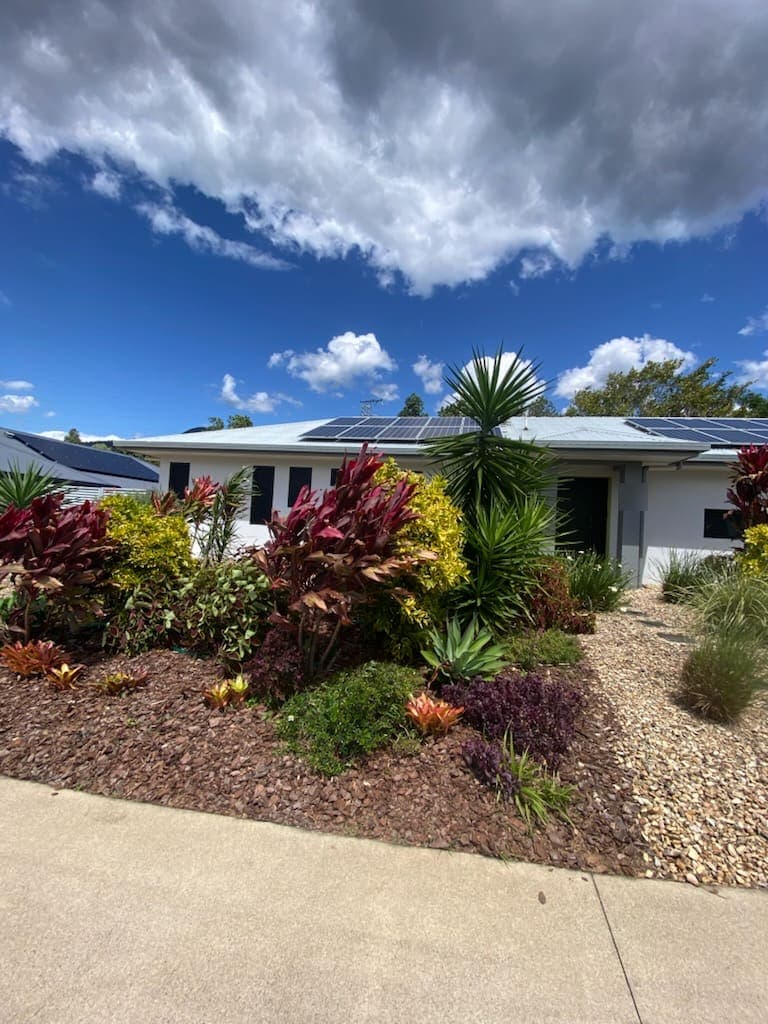
Brush turkeys rake mulch from Cairns garden beds to build incubation mounds, mostly from August to December, while the orange-footed scrubfowl rakes the ground for food. Both are protected in Queensland, and Queensland Government advice is not to destroy a brush turkey mound, so protect the bed with chicken wire, heavy coverings and a shaded decoy mulch pile.
If your mulch keeps ending up on the lawn and the path while a heap of leaves grows in a shady corner of the yard, you have a mound builder. In Cairns there are two suspects, not one: the Australian brush turkey, also called the scrub turkey or bush turkey, and the orange-footed scrubfowl, a smaller bird that builds its mound from rotting plant material, sand and soil, according to BirdLife Australia's Birds in Backyards.
This guide covers how to tell the two birds apart, why they take mulch, when they are busiest, what Queensland law says you can and cannot do, and the options that keep mulch where you laid it. It is written by Trisim, which supplies and lays mulch across Cairns through its garden mulching service, so the focus stays on the bed rather than the bird.
Brush turkey or scrubfowl: which bird is in your Cairns garden?
Two mound-building birds live around Cairns, and they are easy to tell apart. The Queensland Government lists the brush turkey as one of Australia's three mound-building birds, alongside the malleefowl and the orange-footed scrubfowl, and the brush turkey and the scrubfowl are the two found in the Wet Tropics.
- Australian brush turkey: the larger bird, about 70 cm long according to BirdLife Australia, with mainly blackish plumage and a bare red head. The throat wattle is yellow, though BirdLife Australia notes it is mauve in Cape York Peninsula birds.
- Orange-footed scrubfowl: smaller, at around 45 cm, and dark grey to brown all over except for bright orange legs and feet, with a distinctive crest at the back of the head. BirdLife Australia's Birds in Backyards gives its range as including coastal Far North Queensland.
Where you live is a clue too. BirdLife Australia says that in north Queensland the brush turkey usually occurs at elevations above 300 metres, although some wander to lower altitudes in autumn and winter. On the coastal plain, check before you blame a turkey: bright orange feet mean scrubfowl.
Why do brush turkeys and scrubfowl rake mulch out of garden beds?
A brush turkey is building an incubator, and garden mulch is ready-made building material. The Queensland Government explains that the male brush turkey builds a mound of plant litter and soil, adding or removing material to keep it at a constant temperature while the eggs incubate inside.
Scrubfowl mounds, added to each year by different birds, can weigh over 50 tonnes.
Scrubfowl also rake for food. Birds in Backyards says they feed on the ground, using strong legs and large feet to rake for seeds, berries and roots, so a bed can be scratched over even when no mound is going up nearby.
Gardens make it easy for them. The Queensland Government notes that many backyards now resemble the brush turkey's natural habitat, with dense plants, mulched beds and plenty of moisture, and warns that a male can strip a landscaped garden of small plants and mulch in less than a day.
When do brush turkeys and scrubfowl build mounds in Cairns?
Brush turkey mound building peaks from late winter to early summer, while the scrubfowl's breeding season runs longer:
- Brush turkey: the Queensland Government says brush turkeys breed at any time of the year, but most breeding occurs from September to December. Its living-with-brush-turkeys advice, repeated by Tablelands Regional Council, calls August to December the main mound-building period.
- Orange-footed scrubfowl: Birds in Backyards lists a breeding season of July to March.
That timing clashes with the usual mulching calendar. Our guide on which mulch suits a Cairns garden bed suggests laying a fresh layer in spring, from September to November, before the wet season. In a yard the birds already visit, a September layer goes down at the start of their busiest months. Plan the protection at the same time as the mulch.
Are brush turkeys and scrubfowl protected in Queensland? Yes
Yes. Both are native birds protected under Queensland's Nature Conservation Act 1992. The Queensland Government lists the Australian brush turkey as Least Concern under the Act and states that the brush turkey is fully protected in Queensland. Least Concern is a conservation class, not an exemption: the Act defines a protected animal as one prescribed as threatened, near threatened or least concern wildlife.
The scrubfowl is covered by the way the rules are written. The Nature Conservation (Animals) Regulation 2020 makes any native bird least concern wildlife unless it is prescribed in another class, so a native bird that is not listed elsewhere, such as the scrubfowl, falls within the same protection.
Section 88 of the Act says a person must not take a protected animal unless they are an authorised person or the taking is authorised under the Act. The definition of take is broad: it includes to hunt, wound, kill, poison, trap, catch, pursue, lure, injure or harm the animal. Trapping, poisoning or chasing these birds is not a gardening option. This is general information, not legal advice; the Queensland Government brush turkey page is the official starting point.
Can you move or flatten a brush turkey mound? Not on your own
No. The Queensland Government's advice is not to try to destroy a mound or chase a brush turkey away, because it will be ineffective: in its words, the male brush turkey's drive to build a mound is irrepressible.
There is one formal route. If a mound becomes threatening to human health and wellbeing, or is causing financial loss, a licensed bird relocator can capture and relocate male brush turkeys. The relocator will usually charge a fee and will consider the welfare of any eggs in the mound before moving the bird.
Before you call one, the same page notes that your neighbours may enjoy having a brush turkey nearby, and that if a male is removed, the vacancy may be quickly filled by another male. That guidance is written for brush turkeys only, so ask the relocator or the Queensland Government before assuming it applies to a scrubfowl mound.
Leave the mound out of any garden job you book. If you find a sick, injured or orphaned bird, the Queensland Government asks you to contact RSPCA Qld.
Keeping mulch in the bed: what the guidance suggests
The options that hold up are physical barriers, heavier coverings and giving the bird somewhere else to dig. Each step below comes from Queensland Government or Tablelands Regional Council guidance on living with brush turkeys:
- 1Cover mulched beds with chicken wire, secured well with stakes and rocks. On a bed being mulched again, the wire goes straight over the fresh layer.
- 2Use heavy coverings such as rocks and large gravel. The Queensland Government suggests them instead of standard garden mulch, while Tablelands Regional Council's version puts them over the mulch. Either way, the idea is a covering too heavy to rake.
- 3Offer a decoy. Encourage a mound site away from valued gardens by providing mulch in an area of heavy shade with one or more large trees nearby, such as a back corner of the block.
- 4Protect new plants. Use tree guards on newly planted, valuable or vulnerable plants, avoid planting near an existing mound, and put new plants in the ground in late summer, after the main mound-building period.
- 5Do not feed the birds. Let them find their own food.
Weed mat is a separate question. It sits under the mulch, not over it, and the bird guidance does not mention it as a barrier. Our guide on whether weed mat works under mulch covers when it earns its place in a tropical bed.
What about a heavier mulch? None of the guidance names an organic mulch the birds leave alone. Coarse pine bark is heavier duty than fine mulch and breaks down more slowly, so it stays on the bed longer, but treat that as a weed and longevity choice and pair it with wire where the birds are active.
Getting raked beds mulched again and the mess cleared
When a bed has been raked bare, the fix is to clear what has spread, lay it again and decide on protection before the next season. Trisim supplies and lays four different mulches through its garden mulching service, pulls the layer back off stems and trunks as it goes, and quotes the job before anyone starts. Where raked mulch, leaf litter and prunings have built up across lawns and paths, green waste removal covers loading it and taking it away, with disposal included in the quote.
Trisim also mows lawns in suburbs including Kewarra Beach, Trinity Beach and Redlynch, so ask about the beds when you book the lawn. If you are getting a house ready for sale, our pre-listing yard timeline puts mulching about two weeks before photos. Between August and December, add bed protection to that plan so the fresh layer is still in place on photo day.
Common questions from Cairns residents
Yes. The Queensland Government states that the brush turkey is fully protected in Queensland and lists it as Least Concern under the Nature Conservation Act 1992, a class the Act still counts as a protected animal. Under section 88, nobody may take a protected animal without authority, and taking includes trapping, injuring, harming or pursuing it. The practical answer is to protect your garden beds rather than act against the bird.
Not yourself. Queensland Government advice is not to try to destroy a mound, because the male will keep building. Where a mound threatens human health and wellbeing or causes financial loss, a licensed bird relocator can capture and relocate the male, usually for a fee and after considering any eggs. Another male may quickly take over the site, so protecting the beds often matters more.
In Cairns it is one of two birds. An orange-footed scrubfowl is about 45 cm long, dark grey to brown, with bright orange legs and feet and a crest at the back of the head. An Australian brush turkey is larger, around 70 cm, mainly blackish with a bare red head. BirdLife Australia notes north Queensland brush turkeys usually live above 300 metres, so check the feet on lowland mounds.
Cover the mulch so it cannot be raked. Queensland Government guidance is to lay chicken wire over mulched beds and pin it with stakes and rocks, or to use heavy coverings such as rocks and large gravel. A mulch pile in heavy shade under large trees, well away from your main beds, can draw the mound elsewhere. Do not feed the birds, and do not try to chase them off.
Mostly from late winter into early summer. The Queensland Government says brush turkeys can breed at any time of year, with most breeding from September to December, and names August to December as the main mound-building period. The orange-footed scrubfowl runs longer: Birds in Backyards lists its breeding season as July to March. Plan bed protection before laying fresh mulch in spring.
Not on its own, going by the government guidance. The Queensland Government suggests heavy coverings such as rocks and large gravel instead of standard garden mulch, plus chicken wire over mulched beds. It does not name any organic mulch the birds leave alone. A coarse bark stays on the bed longer than a fine mulch because it breaks down slowly, but in a yard the birds work, pair it with wire.
Not quickly. Tropical Topics, a 1999 Queensland Government newsletter hosted by the Wet Tropics Management Authority, says scrubfowl mounds are added to each year by different birds and can weigh over 50 tonnes, and Birds in Backyards says scrubfowl use the same mound for many years. Plan the garden around a scrubfowl mound rather than expecting it to be abandoned after one season, and keep new planting well away from it.
Sources
- Brush turkeys, Queensland Government. Accessed .
- Nature Conservation Act 1992, section 88 and dictionary, Queensland Government (Queensland Legislation). Accessed .
- Nature Conservation (Animals) Regulation 2020, schedule 1: least concern wildlife, Queensland Government (Queensland Legislation). Accessed .
- Australian Brush-Turkeys, Tablelands Regional Council. Accessed .
- Tropical Topics No. 52: Birds breeding, Queensland Government (hosted by the Wet Tropics Management Authority). Accessed .
- Australian Brush-turkey, BirdLife Australia. Accessed .
- Orange-footed Scrubfowl, BirdLife Australia (Birds in Backyards). Accessed .
- Australian Brush-turkey, BirdLife Australia (Birds in Backyards). Accessed .
Last reviewed by Trisim Property Maintenance. Rules and council services change, so check the source before you rely on a date or a fee.
Related services
Lawn mowing around Cairns
From the Knowledgebase
- Which mulch suits a Cairns garden bed?Pine bark, bush mulch, red cypress or tea tree? How each suits a Cairns garden bed, how deep to lay it, how much to order, and where termites come in.Read the article
- Weed mat under mulch in Cairns: where it helps, where it harms and what to use insteadDoes weed mat stop weeds under mulch in Cairns? Why weeds root on top of it, where it still earns its place, and how cardboard and deep mulch compare.Read the article
- Preparing your yard for sale in Cairns: a pre-listing timelineA pre-listing yard timeline for Cairns vendors: what to do 4 weeks, 2 weeks and 1 day before photos, plus wet season regrowth, sprinkler rules and open homes.Read the article
Get raked garden beds mulched again
Tell us which beds the birds have emptied and we will quote the mulch and the labour before any work starts.