
How often should you mow in Cairns? Wet season, dry season and mowing after rain
By Trisim Property Maintenance, CairnsLast reviewed
Most Cairns lawns need cutting at least every fortnight from December to March, when January, February and March each average over 400mm of rain, and some stretch to three weeks in the dry. Mow only when the grass is dry, and only between 7am and 7pm Monday to Saturday, or 8am and 7pm on Sundays and public holidays.
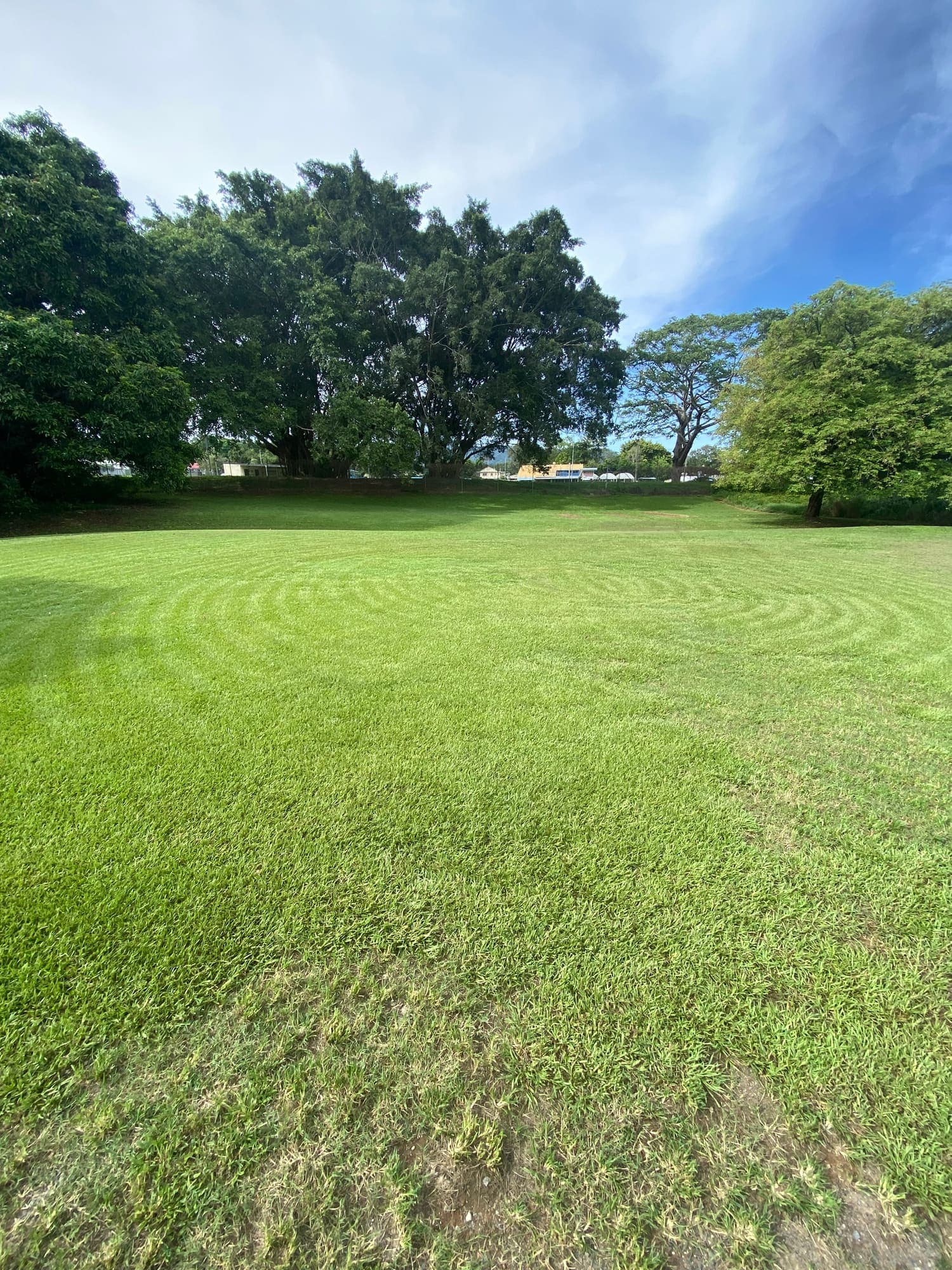
Mowing advice written for southern cities assumes a lawn that slows right down for winter and grows steadily through a mild summer. Cairns does not work like that. Growth follows the monsoon: the lawn races through the humid, rain-heavy months and eases off once the dry season sets in. The right mowing interval changes with it, and so does the practical problem, which in the wet is less about how often to mow than about finding a dry enough day to do it.
This guide sets out a month-by-month interval based on the Bureau of Meteorology's long-term averages for Cairns, the hours Queensland's noise rules allow a mower to run, how to tell when grass is dry enough to cut, and what to do when the lawn has already got away from you. If you would rather hand the whole thing over, Trisim runs a standing fortnightly lawn mowing round across Cairns on the same day each cycle.
Mowing frequency by month in Cairns
There is no fixed number of days that suits every lawn. The honest rule is to mow before the grass has grown so far that one cut would take off more than a third of the leaf (see the one-third rule below). What changes through the year is how quickly a Cairns lawn reaches that point, and the rainfall record gives a clear picture of when growth peaks. These are the Bureau of Meteorology's long-term means for the Cairns Aero station, with the interval each season usually calls for.
- December to March, the wet season proper: December averages 193.8mm and January, February and March each average more than 400mm (404.8mm, 437.5mm and 422.1mm), with around 16 rain days a month from January to March and a mean maximum between 30.7C and 31.5C. A fortnightly cut is the realistic minimum. A lawn kept short may need a weekly cut at the peak to stay inside the one-third rule.
- April and May, the tail of the wet: April still averages 201.8mm across 14.5 rain days and 9am humidity sits at 78%, so April usually stays on the wet-season interval. May drops to 92.0mm and growth starts to ease.
- June to September, the dry: each month averages under 50mm (45.5mm, 33.2mm, 26.5mm and 34.1mm) with about 5 to 7 rain days and mean maximums of 25.9C to 28.2C. A lawn that is not watered slows noticeably, and some stretch to three weeks between cuts. A watered lawn keeps growing, so it may still want a fortnightly cut.
- October and November, the build-up: rain stays low (47.2mm and 87.9mm) while mean maximums climb to 29.7C and 30.8C. Expect growth to pick up as the first storms arrive, and have a regular round in place before December rather than after it.
Across the year Cairns averages 2,025.5mm of rain, and about four-fifths of it falls between December and April. That concentration is why a lawn that looked tidy on a monthly cut in August can be a clearing job by February.
What time can you mow in Cairns?
Queensland's Environmental Protection Act 1994 sets a default noise standard for regulated devices, a group that includes lawn mowers, line trimmers, mulchers, leaf blowers, generators, compressors and power tools. Under it, a regulated device must not make any audible noise at a neighbouring building at these times:
- Monday to Saturday: before 7am and after 7pm.
- Sundays and public holidays: before 8am and after 7pm.
Local councils can set their own standards by local law, and the default applies where they have not. Cairns Regional Council's noise page lists regulated devices, including power tools, generators and lawn mowers, with no audible noise allowed from 7pm to 7am Monday to Saturday and from 7pm to 8am on Sundays and public holidays, which matches the state default. Council says power tool noise complaints are generally dealt with by Council, and it notes that noise inside the permitted times can still be a nuisance if it is excessive.
In practice, the early-morning cut that avoids the midday heat has to wait until 7am, or 8am on a Sunday. Council's table makes no exception for contractors, so the same hours apply whether you or a mowing service is pushing the mower.
Can you mow wet grass?
You can, but it does the lawn no favours. Lawn Solutions Australia sets out the problems. A mower struggles to cut wet grass cleanly, so the leaf tears and bruises instead of being sliced, which stresses the plant. Wet clippings clump together and sit on the surface, blocking air and light and creating the conditions fungal diseases such as brown spot like. After rain the blades also lie flatter under the weight of water, so the cut comes out uneven.
The ground matters as much as the grass. Saturated soil lets the mower wheels sink and leave ruts that throw out the lawn level, and in bad cases the mower bogs and rips up turf. There is also the operator: wet grass on a slope with a spinning blade underneath is a slipping risk. In a Cairns wet season, when rain falls on roughly every second day from January to March, the temptation to mow between showers is real, so it pays to know what dry enough looks like.
How long after rain to wait
There is no set number of hours, because it depends on how heavy the rain was, how much sun and wind the yard gets and how well the soil drains. A light overnight shower on a sunny, breezy block may be gone by mid-morning. A heavy February downpour on low, shaded or clay ground can leave a lawn too soft to mow for a day or more. Check the lawn itself rather than the clock.
- 1Look at the blades. They should be standing up again, not lying flat and glossy with water.
- 2Walk across it. Your shoes should come away without being soaked, and there should be no squelch or water rising around your foot.
- 3Check the low spots and shaded corners. These are the last parts to dry and the most likely to rut.
- 4Run a hand through the grass. If it comes away wet, the clippings will clump. Give it longer.
If the grass passes the first three checks but is still a little damp, cutting at a slightly higher setting with a sharp blade reduces the tearing. If the ground itself is soft, wait. A lawn cut a day late recovers. Ruts from a mower on saturated soil stay until they are levelled.
The one-third rule when grass gets ahead of you
The one-third rule says to take no more than a third of the leaf height off in any one mow. Lawn Solutions Australia traces it to 1955 research at the US Department of Agriculture, which found that removing more than half of the top growth stopped root growth for an average of 11 days. Keep more of the leaf and the roots keep growing.
It also gives you a simple way to set your interval. If you cut at 40mm, the lawn is due before it passes about 60mm, because cutting 60mm back to 40mm takes off a third. When the wet season is putting that much growth on in a week, the lawn needs a weekly cut to stay inside the rule. When it takes three weeks, a three-week interval is fine.
If a run of wet weather has already let the grass get away, do not try to bring it back in one pass. Raise the mower, take off a third, and step it down over the next few cuts. On a block that has gone well past a standard mow, such as a rental left between tenancies or a yard left through a wet season, that recovery can take hours rather than minutes, which is where a one-off clear followed by a regular round saves the lawn from being scalped.
Grass types and mowing height
Each grass variety has its own recommended height, so the first step is knowing what your lawn is. Lawn Solutions Australia's general advice is to mow a little shorter through the warmer months and a little longer through the cooler ones, while keeping to the one-third rule. For a Cairns lawn that means the growing season is also the season that punishes a missed cut, because a lawn kept short has less leaf to spare.
Trisim mulch mows, cutting the clippings finely so they fall back to the root zone rather than being bagged. Regular cuts suit that approach because the clippings stay small, and the same reasoning applies to anyone mowing their own lawn: short, frequent cuts on dry grass leave less for the lawn to digest than one heavy cut on a wet day. If you manage a rental, our rental yard maintenance calendar sets the mowing round alongside the other seasonal yard jobs.
We mow across the Cairns suburbs, including Redlynch, Kewarra Beach, Bayview Heights and Mooroobool. Each suburb page covers what the wet season means for lawns in that part of town.
Common questions from Cairns residents
At least every fortnight from December to March, and weekly at the peak if you keep the lawn short. January, February and March each average more than 400mm of rain at Cairns Aero, with around 16 rain days a month and mean maximums above 30C, so growth is at its fastest. The practical test is the one-third rule: mow before a single cut would take off more than a third of the leaf height.
It is better not to. Wet grass tears and bruises instead of cutting cleanly, wet clippings clump and can encourage fungal disease such as brown spot, and mower wheels leave ruts in saturated soil. The blades also lie flat after rain, so the cut comes out uneven. If the grass is only slightly damp and the ground is firm, a sharp blade on a higher setting limits the damage. If the soil is soft, wait.
Wait until the lawn passes a simple check rather than a set number of hours. The blades should be standing upright, your shoes should not get soaked walking across it, and nothing should squelch underfoot, including in the low and shaded spots. After a light shower on a sunny block that can be a few hours. After a heavy wet season downpour on poorly drained ground it can be a day or more.
Between 7am and 7pm Monday to Saturday, and between 8am and 7pm on Sundays and public holidays. Queensland's default noise standard bans audible noise from regulated devices such as mowers, line trimmers and leaf blowers outside those hours, and Cairns Regional Council publishes the same times. Council handles power tool noise complaints and notes that noise within the permitted hours can still be a nuisance if it is excessive.
For most lawns a fortnight is the longest sensible gap from December to March, not a comfortable one. With more than 400mm of rain in each of January, February and March, a lawn left for three or four weeks usually needs more than a third taken off, which stresses the grass and can scalp it. If your lawn outgrows a fortnight, move to a weekly cut through the peak months.
It depends on the contractor, so ask when you book. Cutting saturated ground ruts the lawn and tears the grass, so a good contractor will not mow a waterlogged yard just to keep to the schedule. Trisim runs a standing fortnightly round on the same day each cycle, and how a washed-out visit is handled is worth settling at the quote so there are no surprises in February.
Sources
- Monthly climate statistics: Cairns Aero (031011), Bureau of Meteorology. Accessed .
- Noise regulation under the Environmental Protection Act 1994 (fact sheet), Queensland Government. Accessed .
- Noise, Cairns Regional Council. Accessed .
- How wet is too wet for mowing?, Lawn Solutions Australia. Accessed .
- Is there any truth to the 'only-one-third' rule?, Lawn Solutions Australia. Accessed .
- What height should I mow my lawn?, Lawn Solutions Australia. Accessed .
Last reviewed by Trisim Property Maintenance. Rules and council services change, so check the source before you rely on a date or a fee.
Related services
Lawn mowing around Cairns
From the Knowledgebase
- A yard-ready rental: the Cairns landlord and property manager maintenance calendarA Cairns rental yard calendar and routine inspection checklist: wet and dry season jobs, RTA inspection rules, and who handles mowing, gutters and trees.Read the article
- Lawn and garden help for older Cairns residents: options and fundingPensioner lawn mowing services in Cairns: how older residents and families arrange mowing, private or funded by aged care, NDIS or DVA, and what to ask.Read the article
Let the wet season be someone else's problem
Book a standing fortnightly mowing round before December, on the same day each cycle, and get a free quote first.